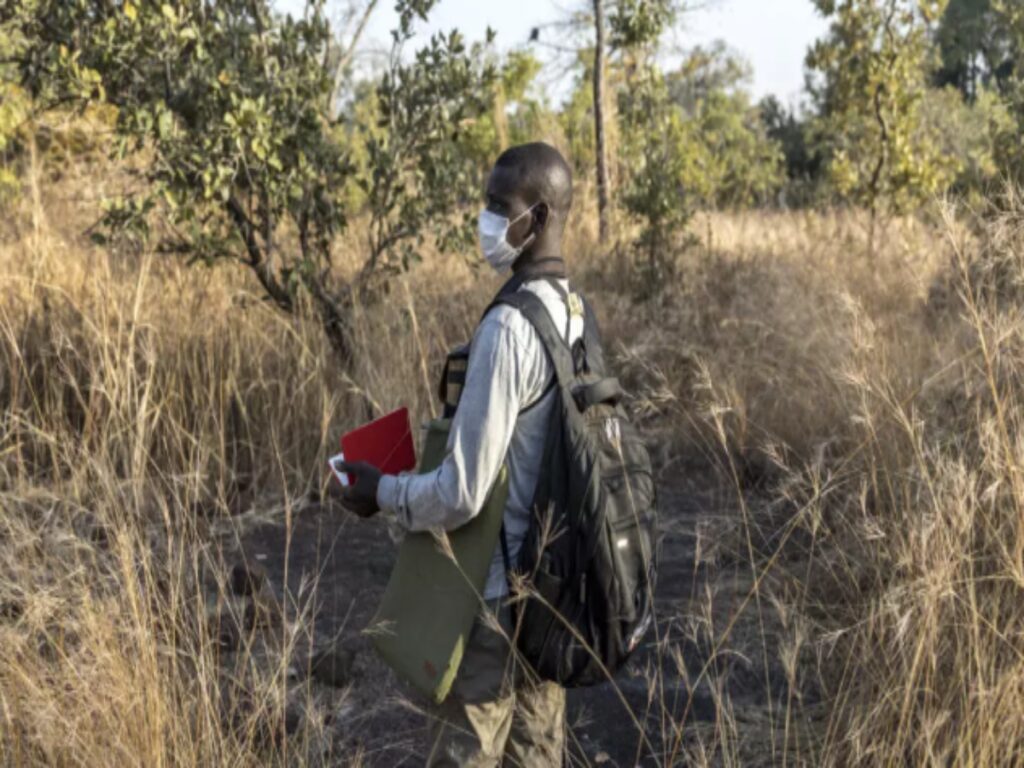
Fifteen years ago, 37-year-old Michel Tama Sadiakhou’s life took a big turn thanks to a group of spear-wielding chimpanzees. Instead of facing the life-threatening conditions of informal gold mining, a common fate for many in southeastern Senegal, he now dedicates his efforts to studying these rare primates.
He is one of five residents of nearby villages in Senegal’s Kedougou region—members of the Bedik and Bassari ethnic groups—who, with the exception of one, do not have a high school diploma and are working on a project about the region’s extremely rare savannah-dwelling chimpanzees.
From Gold Mines to the Bush
For many of them, the Fongoli Savanna Chimpanzee Project has provided an answer to the pressing question, “What happens when locals are involved in conservation efforts?” in addition to demonstrating a thorough understanding of science.
Sadiakhou told AFP that his involvement in the Fongoli Savanna Chimpanzee Project was “really a stroke of luck”, as reported by Africa News.
Sadiakhou, a Bedik father of four, worked in the gold mines, referred to locally as the dioura, after graduating from high school.
However, after seeing Jill Pruetz, founder of the project and others drive past his village several times, he decided to apply for work and was hired for the project in 2009, despite never having seen a chimp before.
He now describes the apes as a “second family” and serves as the head researcher.
“When I’m with the chimpanzees, even if I’m alone, it’s like I’m with other people,” Sadiakhou said.
The World’s Rarest Chimpanzees
The Fongoli Savanna Chimpanzee Project was established in 2001 by American primatologist Jill Pruetz. During her research on a group of approximately thirty West African chimpanzees, she made several significant discoveries, leading her to name them the Fongoli chimps.
The Fongoli females are the only documented animals in the world to regularly hunt with tools, fashioning branches into spears for killing smaller primates known as bush babies.
The Fongoli chimps, currently numbering 35, were the first and for a long time the only group of savannah chimpanzees to adapt to the presence of researchers.
The local researchers take notes and select one of the group’s ten adult males to follow each day. They record everything from vocalisations to food intake, social interactions, and the rhythmic beating of trees known as buttress drumming.
Pruetz’s findings have revealed that despite the extreme savannah heat, the Fongoli apes have learnt to soak in natural pools, rest in cool caves, and remain calm in the presence of fire.
Pruetz believes that their adaptations to a landscape on the outskirts of what is possible for their species can shed light on human evolution and the early hominins who lived in similar climates millions of years ago.
The primate group resides in the bush, instead of a typical forest habitat, alongside other similar chimp groups in Senegal’s Kedougou region near the borders of Mali and Guinea.
Illegal Mining and the Cost of Survival
According to a 2018 government study, 98% of Senegal’s gold mining sites are in the Kedougou region, which is home to the Fongoli range. According to data from 2021–2022, it is also among its poorest areas, with a poverty rate of over 65%.
At one of the numerous dioura locations within the Fongoli chimps’ territory, a large opening in the earth opens into a deep tunnel where exhausted, muddy-looking men come and go.
According to a 2018 study, over 30,000 individuals are employed in Senegal’s traditional gold mining industry. Aliou Bakhoum, director of the NGO La Lumiere in Kedougou’s regional capital, noted that this number has only risen in recent years.
The dioura can be profitable for those who find gold, but it largely depends on “luck”, Bakhoum told AFP. He added that the work is risky due to the lengthy, excessively deep tunnels and the possibility of cave-ins.
Nazaire Bonnag, a 31-year-old fellow researcher who also overcame the dioura, recounted his experience, saying, “I saw someone go down there (into the mines) and he never came back up.”
That day, Bonnag decided, “No, I can’t continue like this,” after it was confirmed that the man had suffocated from gas and a rope was used to pull his body out.
Illegal mining continues to devastate land, livelihoods, and lives across Africa. It has taken the popular names of “galamsey” in Ghana, and “zama zamas” in South Africa, but the devastation these operations cause is evident to the land and to the people involved.
Consequences for Economy and Environment
According to a DW report, the South African government claims that the practice has severely damaged the country’s economy, with an estimated 70 billion rand ($4 million, €3.6 million) in gold lost annually, resulting in huge revenue losses for both the government and the mining industry.
In Ghana, the consequences of these activities are visible in the loss and encroachment of forest reserves, as well as the severe pollution of water bodies, prompting ongoing public outcry and government intervention to bring these defaulters to justice.
The miners themselves, according to an Interpol report on illicit gold mining in Central Africa, are at the bottom of the chain. They are mostly vulnerable people who forfeit their security in exchange for the remote possibility of escaping poverty. According to the report, 50% of artisanal miners in Africa are women, and 10% are children.
The impact of these activities is also reflected in the lives of the primates that Sadiakhou and his research team have dedicated years to studying.
As reported by the AFP, the gold mining surge since the 2010s has attracted not only locals but also individuals from neighboring West African nations, creating new challenges for the chimps, including heightened water pollution, deforestation, and the transmission of human diseases.
Conservation as an Economic Solution
With recurring talks about how to curb the illegal mining menace, the solution to involve indigenes in conservation activities seems to be one of the ways more people will grow to love and understand the environment they live in.
Dondo “Johnny” Kante, the project’s manager from a nearby Bedik village, shares this view. He believes that involving local workers encourages the broader community to take “interest in the project”.
He hoped that the researchers’ work would encourage other residents to “continue to support, protect and truly work for the well-being” of the Fongoli chimps.
This strategy shows that conservation is not just about safeguarding wildlife but also about providing practical substitutes for hazardous, unofficial labour that keeps communities in poverty and danger cycles.