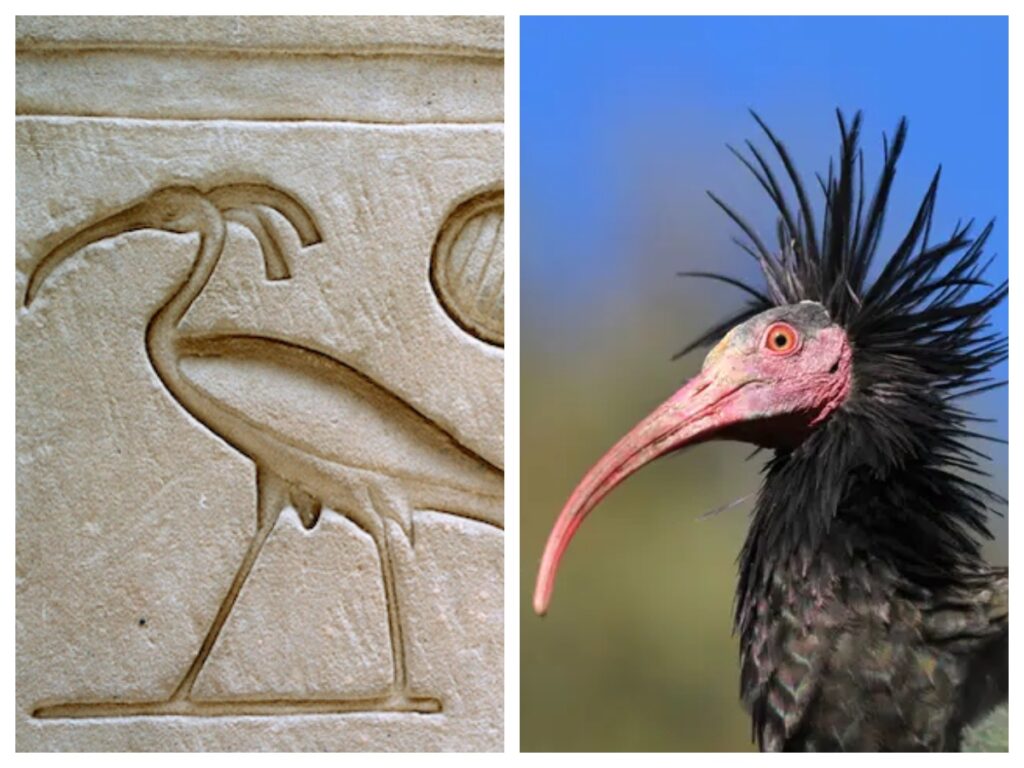
The rare northern bald ibis, once revered in Ancient Egypt, was driven to near extinction over several centuries, with dramatic declines beginning as early as the 17th century. Today, breeding and rewilding efforts in Rabat, Morocco, are driving a rare conservation breakthrough.
What is the northern bald ibis?
The migratory birds are distinguished by their black and vibrant green plumage, bald red head, and long, curved beak.
According to Yale Environment 360, the bird is known as a ‘liethe’ or a ‘waldrapp’. Its scientific name, Geronticus eremita, means ‘old man’, owing to its unusual bald head. In previous centuries, the species was common in northern and eastern Africa, Asia Minor, Arabia, and parts of Europe.
The northern bald ibis was revered by the ancient Egyptians as an afterlife deity, and hieroglyphs from thousands of years ago bear a striking resemblance to it. The depiction of their distinctive outline represents the word akh, meaning “spirit”.
From the 1960s to the 1980s, the bald ibis was frequently seen in the expansive steppes and farmland of central Syria and southern Anatolia. Its noisy colonies, nesting on towering cliffs, were hard to overlook for both locals and visitors.
According to elderly Bedouin nomads, the ibis was regarded as a symbol of wisdom. Much like the ancient Egyptians thought of ibis in general (as a taxonomic family), they used to gather their chicks for food by riskily using ropes fixed at the top of the cliffs, as reported by Moganbay.
Journey to Extinction
The decline and extinction from the wild of Birecik’s roughly 1,000-bird colony is well documented; it was decimated first by the use of DDT in the 1960s, then by an increasingly low recruitment from migration. The colony had become semi-captive and thus no longer migratory by 1989.
The northern bald ibis is now extinct except for a small population of about 600 wild birds in Morocco, a semi-wild population of about 200 birds in southern Turkey that relies on captive breeding, and possibly a few birds in Eastern Africa.
The species was downlisted from critically endangered to endangered on the IUCN Red List in 2018 due to significant conservation efforts to protect Morocco’s breeding grounds.
Conservation Initiatives
Currently, staff at the National Zoological Garden of Rabat protect the birds and ensure they are well fed, healthy, and ready to breed, according to Africa News.
Similar initiatives to save the birds have been carried out throughout Europe. One such initiative was carried out by an Austrian conservation and research group, which succeeded in changing the species’ classification from “critically endangered” to “endangered”.
Ten years after the Rabat Zoo saved about twenty birds in 2015, their numbers have doubled, according to Saad Azizi, head of the veterinary and zoological service.
The staff recreated their breeding environment by separating areas for mating and reproduction, as well as placing branches to assist the birds in building their nests.
According to Azizi, the species is renowned for its strong pair bonds, and each bird selects its preferred nesting site. Sometimes, for the duration of their lives, the pair stays together and reproduces with the same partner.
The end of March marks the start of the breeding season, and eggs hatch in early June.
According to bird breeding technician Hafid Ouchtarmoun, each couple raises one to two chicks under close veterinary supervision.
The birds at the zoo eat small pieces of meat, carrots, and rice in a mixture that mimics their natural diet.
To prevent them from escaping or interacting with other migratory birds, they drink water from the ground and spend time perched on trees that are enclosed by netting.
The birds are also routinely inspected, which lowers the chance of disease transmission.
As part of a programme designed to increase the population and guarantee their survival, the birds are progressively released into the wild once they are deemed ready and capable of adapting.
Additionally, specialists can monitor and track the birds, both within the zoo and after they are released into the wild, because they are equipped with identification rings on their legs.
These conservation efforts will hopefully lead to an upsurge in the number of these creatures, which hold benefits for the ecosystem.